
H2Nodes — Milestone 10: Riga Hydrogen Refuelling Station (HRS) Upscaling — Research Summary (Part I)
Abstract
This study consolidates the theoretical framework for hydrogen refuelling station (HRS) upscaling in Riga. It covers production pathways (electrolysis and steam-methane reforming), storage and dispensing architecture, regulatory and standards mapping, hydrogen quality assurance, documentation requirements, and environmental & safety baselines (air emissions, noise, ATEX zoning, and risk assessment methods). The outcome is a structured foundation for site-ready Part II design work and permitting.
Research Objectives
- Summarise HRS production, storage and dispensing modules for scalable upscaling.
- Map the applicable EU/LV regulatory framework and harmonised standards for HRS design, construction and operation.
- Outline hydrogen quality control and station documentation requirements.
- Establish environmental (air, noise) and safety (ATEX, QRA) assessment baselines relevant to HRS siting and design.
Methods
The draft source was structured into a research workflow: technology definition, standards/legal synthesis, and environmental & safety baselining.
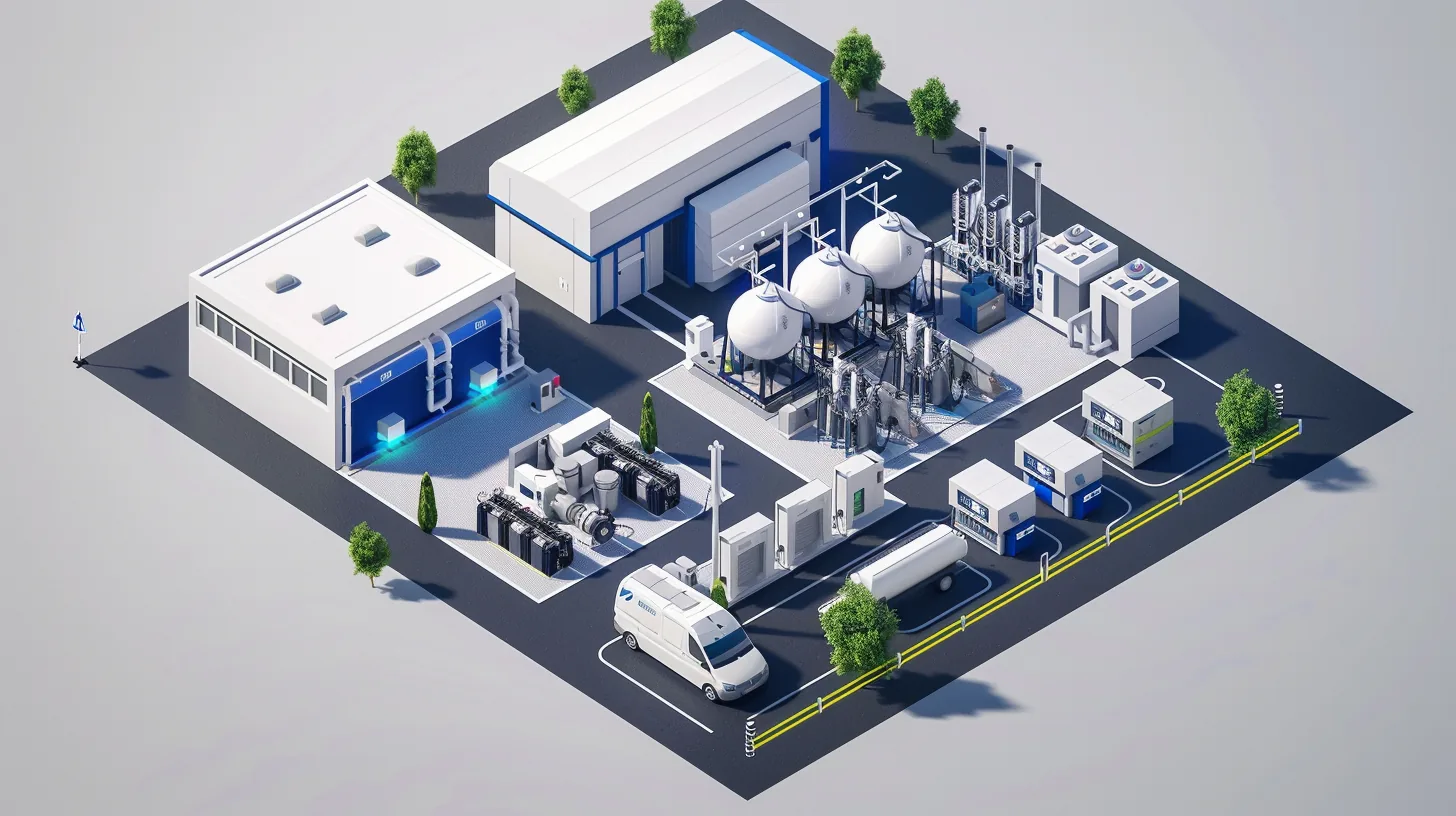
- Technology: modular blocks (NG compression, water treatment/compressed air, hydrogen generation, H2 compression to supply buffers, fuelling control, dispensers).
- Standards/legal synthesis: EU directives and LV cabinet regulations; EN/ISO/SAE standards and industry codes (EIGA, PGS).
- Hydrogen quality: product specification and on-going quality control framework for PEM FCEVs.
- Environmental: equations and factors for combustion emissions (SMR variants); noise mapping approach and indicators (Lday/Levening/Lnight).
- Safety: ATEX zoning per EN/IEC 60079-10-1; hazard identification; quantitative risk approach, ignition probabilities, consequence criteria, and safety distances from recognised guidance.
Results
Technology Building Blocks (public summary)
- Production: water electrolysis (≥99.999% purity typical) and steam-methane reforming (SMR).
- NG compressor: boosts low-pressure natural gas where required for SMR units (dual compressors, cooling, automation).
- Water treatment & compressed air: deionised/process water supply, instrument-air compressors/dryers for controls and valves.
- Hydrogen generation: packaged SMR or electrolysis skids with utility interfaces (water, power, air, NG for SMR).
- Hydrogen compression: raise product from low pressure to ~200 bar supply buffers (dual compressors, cooling, automation).
- Supply storage: buffer cylinders up to ~200 bar between production and fuelling control to decouple operations and enable trailer loading if needed.
- Fuelling storage: two-tier racks (indicatively ~500 and ~1000 bar) to enable cascade fills.
- Fuelling control module: compressor, controls and cooling interfacing supply storage, fuelling storage and dispensers.
- Dispensers: dedicated HDV (350 bar) and LDV (700 bar) units; protocols per SAE J2601/J2601-2 with/without IR comms (SAE J2799); connectors per ISO 17268.
- Road supply interface: MEGC/tube-trailer unloading/loading arrangements for delivered or outbound hydrogen.
Regulatory & Standards Framework
Key layers referenced in the draft include (non-exhaustive):
- Planning & Environment (LV): Environmental Impact Assessment Law; Pollution Law; Cabinet Reg. No.1082 (A/B/C polluting activities & permits); Reg. No.204 (territorial planning).
- Design & Equipment (LV/EU): AFID 2014/94/EU (hydrogen filling points); PED 2014/68/EU; ATEX 2014/34/EU; Machinery 2006/42/EC; Electrical (LVD) 2014/35/EU; TPED 2010/35/EU.
- Operation & Safety Management (LV): Labour Protection Law; Explosive Atmospheres at Work; Internal supervision of work environment; Fire Safety and Fire-fighting Law; Dangerous Equipment; Protection Zone; Civil Protection.
- Core HRS standards: ISO 19880-1 (general station requirements); EN 17127 (refuelling points & protocols); EN 17124 (fuel quality); ISO 17268 (connectors).
- Additional practice: EIGA IGC 15/06 (gaseous H2 stations); PGS35 (delivery installations); EIGA IGC 121/14 (pipeline systems).
- Production standards: ISO 22734 (electrolysers); ISO 16110-1 (fuel-processing H2 generators).
- Fuelling protocols & comms: SAE J2601 (LDV), SAE J2601-2 (HDV), SAE J2799 (IR comms).
- Hydrogen quality control: ISO 19880-8 (fuel quality control program).
- Transport & delivery: ADR framework (Directive 2008/68/EC) and TPED 2010/35/EU for transportable pressure equipment.
HRS Documentation Requirements
- Declarations/certificates of conformity; equipment manuals with operating/maintenance/safety instructions.
- Safeguards and interlock descriptions (with diagrams); technical specifications and setpoints.
- Assembly/layout drawings; PFD/P&ID; electrical; emergency systems.
- Risk studies (HAZOP/HAZID), ATEX area classification, FAT/SAT protocols, installation documentation.
- Operational docs: work safety instructions; emergency response plan; risk assessment; environmental & fire-safety plans; explosive-area identification; MEGC/tube-trailer delivery procedures; sampling procedure; public dispenser instructions; H2 quality assurance plan.
- Permits/registrations: pollution permit; dangerous-equipment registry (pressure equipment complexes); fire safety inspection report.
Environmental & Safety Baselines (public)
- Air emissions (SMR variants): use LV combustion-plant factors and equations to estimate NOx/CO/CO2; verify against LV limit values; ensure compliant burner selection.
- Noise: model with recognised mapping software against day/evening/night indicators (Lday, Levening, Lnight) and applicable zone limits; design barriers/enclosures as needed.
- ATEX zoning: classify internal/external zones per EN/IEC 60079-10-1 around potential leak sources; locate reliefs/vents accordingly.
- Risk: follow Dutch QRA guidance for scenarios (pipeline/storage/dispenser/MEGC); include ignition probabilities and consequence criteria (e.g., 0.3 bar overpressure; 10 kW/m² jet-fire heat flux) and size safety distances using standards/guidelines (NPR/PGS, EIGA).
Discussion
- A modular HRS architecture supports stepwise upscaling and mixed supply modes (on-site production and delivered hydrogen).
- Standards harmonisation (ISO/EN/SAE) enables interoperability and acceptance testing (FAT/SAT) while maintaining a risk-based design approach.
- Electrolysis variants avoid direct air emissions and align with RES integration; SMR variants require combustion emission checks but may support near-term availability.
- Acoustic design and ATEX zoning are primary siting constraints; risk-informed safety distances can influence plot layout and neighbouring land use.
- Robust documentation and hydrogen-quality control underpin safe commissioning/operation and regulatory approvals.
Limitations
- Source is a draft; some placeholders and tables are incomplete in the original layout.
- No site-specific background air/noise data or economics are included here.
- Figures are indicative and rounded; final values depend on supplier data and detailed design.
Recommendations & Next Steps
- Proceed to site-specific Part II design using the modular blueprint and standards set mapped here.
- Engage early with authorities on EIA/pollution permits and civil protection planning; align documentation sets and acceptance tests (ISO 19880-1).
- Select equipment with proven conformity (PED/ATEX/ISO) and prepare vendor-agnostic RFI/RFQ packages.
- Initiate detailed noise modelling and QRA to define barriers, safety distances and emergency planning; confirm ATEX zoning and ventilation philosophy.
- Implement a hydrogen fuel quality control program consistent with EN 17124 and ISO 19880-8.