
H2Nodes — Milestone 10: Riga Hydrogen Refuelling Station (HRS) Upscaling — Research Summary (Part II)
Abstract
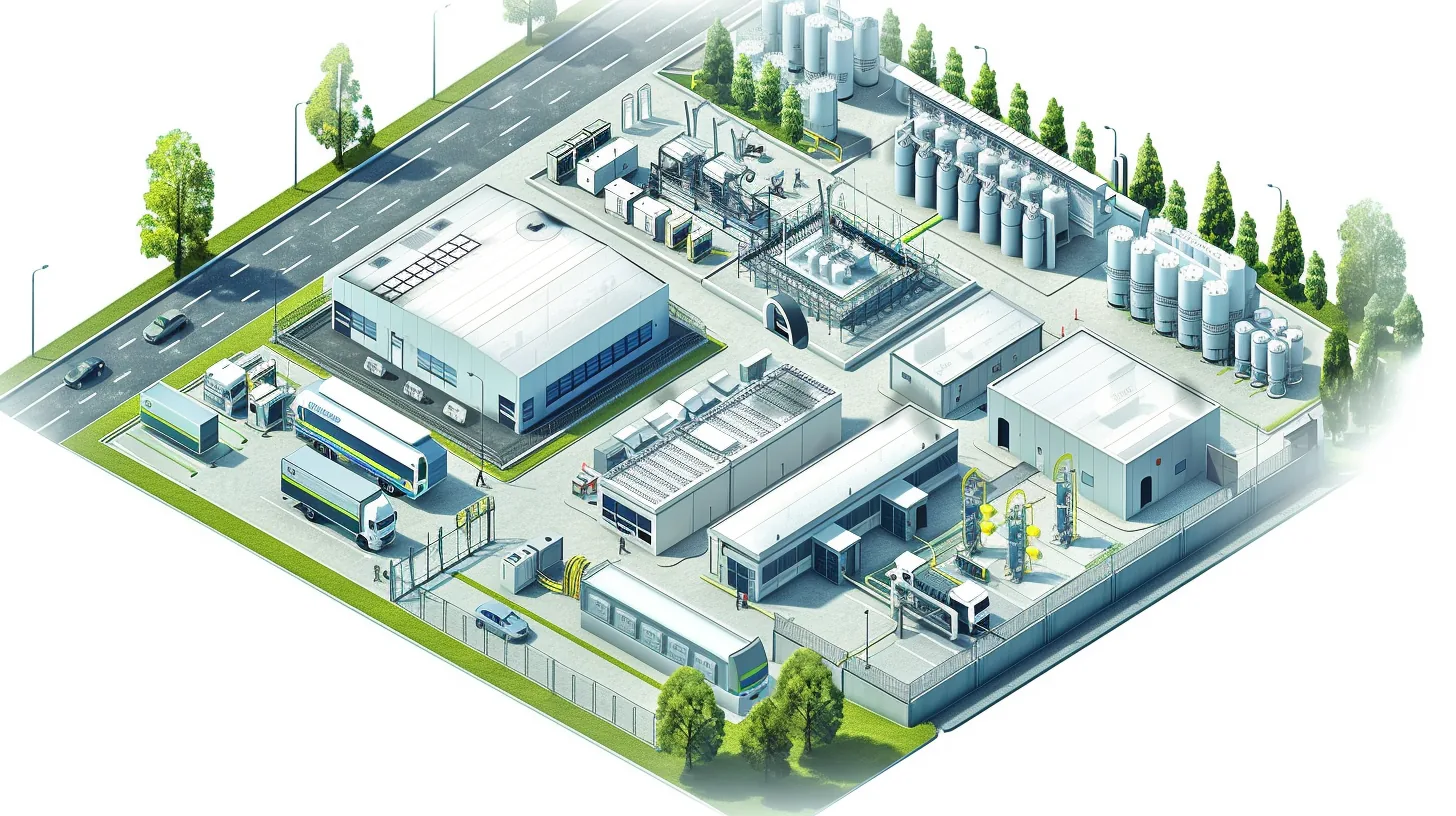
This research consolidates the upscaling pathways for a hydrogen refuelling station (HRS) ecosystem centred on Riga, with extensions to a regional city and a movable HRS concept. We translate draft design material into a research format—objectives, methods, results, and implications—assessing four options: (1) Step-1 upscaling of the existing Riga HRS, (2) Step-2 upscaling to ~1.2 t H2/day with MEGC logistics, (3) a new electrolysis-based regional HRS (~1.29 t/day), and (4) a large-scale electrolysis concept (~4.94 t/day). Environmental (air/noise) and safety risk modelling indicate targeted acoustic mitigation, risk-based layout, and full permitting for larger variants.
Research Objectives
- Define scalable upscaling options for the existing Riga HRS and quantify indicative capacities.
- Evaluate a regional electrolysis HRS concept and a large-scale electrolysis option for Riga.
- Propose a movable refuelling-only HRS for piloting or temporary coverage.
- Summarise environmental (air, noise) and safety risk outcomes from draft modelling and derive design implications.
- Outline permitting, standards compliance and next steps toward deployment.
Methods
Draft material was structured into a research workflow: concept definition, modelling, and standards/permitting synthesis.
- Concept definition: modular architecture (production → compression → storage → fuelling control → dispensers), with phased capacity increases and option for MEGC loading/unloading.
- Operational assumptions: heavy-duty fleet overnight refuelling window (~6 hours) informs dispenser count, storage split and compressor sizing.
- Air dispersion: Gaussian model for variants with combustion sources; compared to national threshold values.
- Noise: recognised mapping software vs day/evening/night limits; mitigation via barriers and enclosures.
- Risk (QRA): leak/rupture scenarios across pipelines, storage, dispensers and MEGC; ignition probabilities and consequence distances.
- Standards: ISO 19880-1/-8, EN 17127, EN 17124, ISO 17268, SAE J2601/-2, SAE J2799; PED, ATEX, Machinery, LVD, ADR.
- Permitting: synthesis aligned with industrial zoning and environmental approvals.
Results
Riga HRS — Step 1 Upscaling
- Concept: augment existing station to ~540 kg H2/day with expanded storage (~870 kg split between supply and high-pressure fuelling banks).
- Throughput aim: overnight 350-bar HDV refuelling; limited 700-bar LDV.
- Utilities (OoM): +hundreds of kW electrical; process water a few m3/h; increased NG supply (SMR variant).
- Environmental: modelled station-only concentrations below national thresholds; verify baseline in detailed design.
- Noise: predicted night exceedances toward mixed-use residential; acoustic barrier recommended at sensitive boundary.
- Risk: ~10-6/yr individual-risk contour localised near H2 storage/350-bar dispenser; acceptable within industrial criteria with mitigation.
Riga HRS — Step 2 Upscaling
- Concept: duplicate to ~1,170–1,200 kg H2/day; storage ~1,740 kg; extra 350-bar dispensers and second fuelling-control module.
- Logistics: enable MEGC loading to supply other sites; confirm road safety and SOPs.
- Utilities: scaled increases in power, water and gas; confirm with providers.
- Noise: larger evening/night exceedance footprint; enhanced barriers/enclosures and careful equipment selection required.
- Risk: greater consequence distances (e.g., MEGC hose rupture); remains manageable with layout protection and procedures but may constrain neighbouring land-use changes.
Regional Electrolysis HRS — Jelgava
- Concept: on-site electrolysis ~1,290 kg H2/day; 350-bar bus priority; limited 700-bar LDV.
- Air: no direct combustion emissions; address grid/RES in energy strategy.
- Noise: compressor/auxiliaries dominated; compliant at nearest residences with assumed mitigation.
- Risk: individual-risk contours within industrial zone; apply standard separations and emergency planning.
Large-Scale Electrolysis Concept — Riga
- Concept: ~4,940 kg H2/day electrolysis; ~200+ bus equivalent duty cycle (350-bar focus; limited 700-bar).
- Permitting: full EIA, detailed QRA and acoustic design from outset; early grid/RES strategy and stakeholder engagement.
Movable HRS
- Concept: refuelling-only module (~150 kg H2/day) supplied by road trailers; 350-bar for ~10 buses in ~6 hours.
- Use cases: pilots, construction-phase coverage, low-volume corridors.
Discussion
- Decarbonisation: SMR supports near-term scale but adds combustion emissions; electrolysis shifts emissions off-site and aligns with RES.
- Operations: the 6-hour overnight window is the main driver of compressor/storage sizing and dispenser count.
- Acoustics: compressors and cooling dominate; barriers/enclosures and equipment selection are pivotal for night compliance.
- Safety: hose failures at dispensers/MEGC are key drivers; procedures, separation and interlocks are central mitigations.
- Network view: MEGC logistics link sites during ramp-up; a regional electrolysis hub complements a central high-throughput site.
Limitations
- Source document is a draft; some references/figures unresolved.
- Air-quality modelling compared station emissions to thresholds without measured background concentrations.
- Quantities are indicative and rounded; site-specific utilities, acoustics and risk contours require detailed inputs.
- Economics (CAPEX/OPEX) and procurement strategy are out of scope.
Recommendations & Next Steps
- Advance Step-1 Riga HRS to detailed feasibility and permitting with acoustic-barrier design, refined dispenser placement and cooling strategy.
- Pursue Step-2 only with confirmed fleet growth; integrate MEGC logistics and update risk/noise models.
- Progress the regional electrolysis HRS to concept select with vendor-agnostic RFI/RFQ; validate grid capacity and water/process integration.
- For the large-scale electrolysis concept, initiate EIA scoping, grid/RES strategy and community engagement at project start.
- Standardise acceptance: PFD/P&ID, electrical and ATEX area drawings, FAT/SAT procedures and H2 quality control per EN 17124/ISO 19880-8.